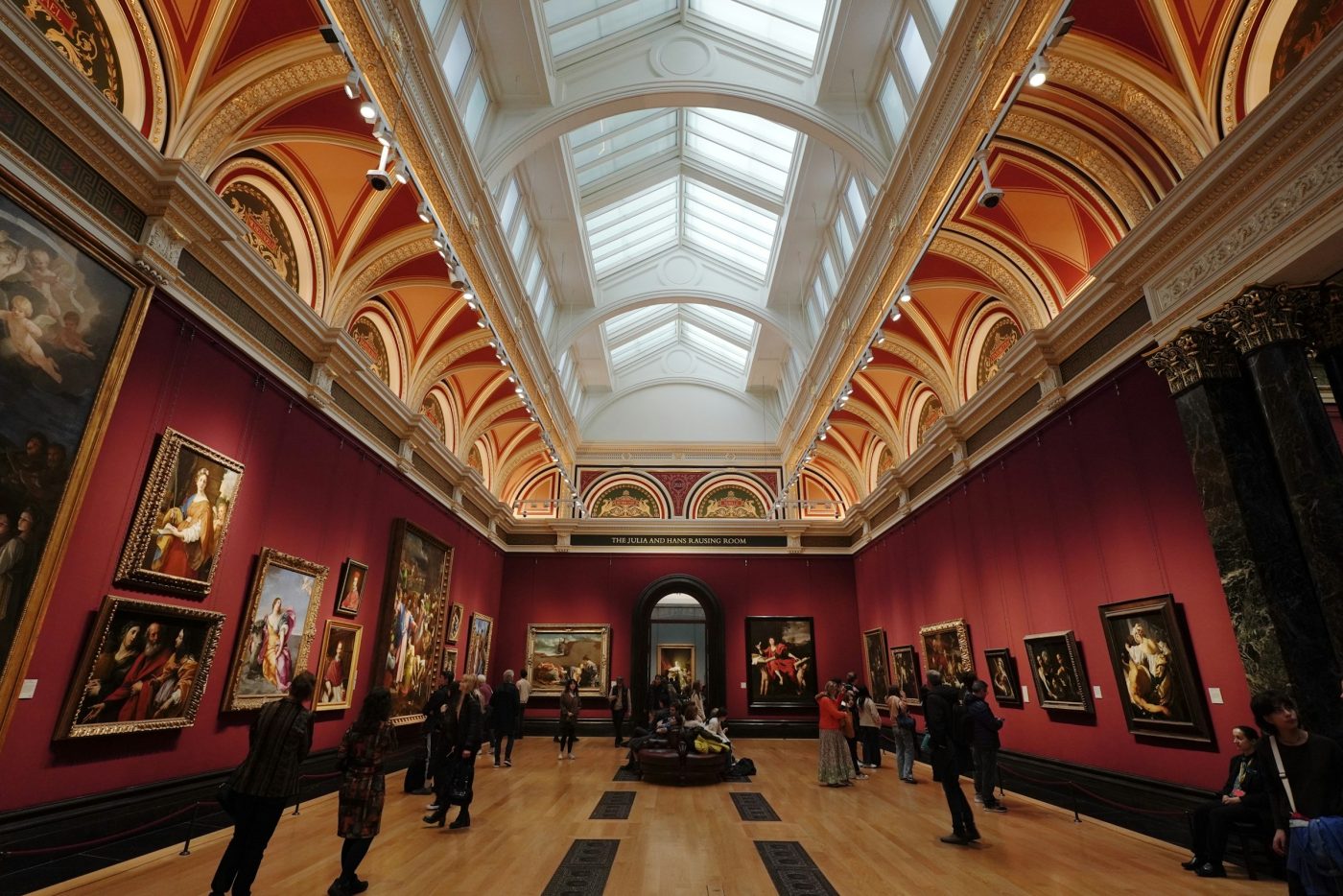
The National Gallery has no ticketed exhibition open at all today. Its own website says so, under the heading Current exhibitions: there are none, and the paintings are free to enjoy every day. Its next show opens on 3 October.
That is the trouble with every list of the best London exhibitions. They are undated, so you cannot tell whether the show being recommended closed last month or has not opened yet.
So this page lists what is on, with the date each one closes, checked on 26 September 2026 and rechecked on 28 September, and then covers the part no list bothers with: what is free, what is not, and how to get into the shows that sell out.
Exhibitions in London now, and when each one closes
Checked against each institution’s own listings on 26 September 2026 and rechecked on 28 September 2026. If you are reading this later, the closing dates tell you what is still true without anybody having to rewrite a sentence.
| Exhibition | Where | Closes | Price |
|---|---|---|---|
| James McNeill Whistler | Tate Britain | ClosedEnded 27 Sep 2026 | Ticketed |
| Richard Dadd | Royal Academy | 25 Oct 2026 | £15 |
| Day | Royal Academy | 8 Nov 2026 | Free |
| Frida: The Making of an Icon | Tate Modern | 3 Jan 2027 | £25 |
| Ana Mendieta | Tate Modern | 17 Jan 2027 | Ticketed |
| Nicole Eisenman | Royal Academy | 5 Feb 2027 | Free |
| Julio Le Parc: Light. Colour. Action. | Tate Modern | 3 May 2027 | Ticketed |
Whistler at Tate Britain closed on 27 September 2026, the day after this was checked, and by the 28th it had gone from Tate Britain’s own listings. It stays in the table marked Closed rather than quietly disappearing, so anyone still looking for it finds the answer here. That is the entire argument for dating a list: a page without that column would still be recommending it in November.
Two of the six still running are free, and both are at the Royal Academy, which runs a serious free programme alongside its ticketed shows and gets almost no credit for it. Nicole Eisenman runs free until February.
The best exhibitions in London opening in the next few weeks
If nothing above suits, the autumn is unusually front loaded. Every one of these opens within eight weeks of the check date.
| Exhibition | Where | Runs |
|---|---|---|
| Painting the French Riviera | Royal Academy | 2 Oct 2026 to 31 Jan 2027 |
| Renoir and Love | National Gallery | 3 Oct 2026 to 31 Jan 2027 |
| The 90s: Art and Fashion | Tate Britain | 8 Oct 2026 to 14 Feb 2027 |
| Light and Magic: The Birth of Art Photography | Tate Modern | 14 Oct 2026 to 21 Feb 2027 |
| Yinka Shonibare and Thomas Gainsborough | National Gallery | 15 Oct 2026 to 7 Feb 2027 |
| Vanessa Bell and Duncan Grant: Inside Bloomsbury | Tate Britain | 12 Nov 2026 to 11 Apr 2027 |
| Van Eyck: The Portraits | National Gallery | 21 Nov 2026 to 11 Apr 2027 |
| Peggy Guggenheim in London | Royal Academy | 21 Nov 2026 to 14 Mar 2027 |
The National Gallery has three of the eight, having had none at all on the date this was checked. If somebody told you there was nothing on there, they were right, and they are about to stop being right.
The discount almost nobody uses
Frida at Tate Modern is £25. The same ticket is £5 if you are between 16 and 25.
Tate Collective is free to join, applies across Tate exhibitions, and takes eighty per cent off the door price. It is not hidden. It is simply never mentioned by the lists recommending the show. At the Royal Academy the equivalent is Friends of the RA, who go free, which changes the membership arithmetic below considerably.
The other easy saving is the hour. Frida runs until 21.00 every Friday and Saturday, and those evening slots sell more slowly than weekend afternoons. Same ticket, emptier room.
The split that governs everything
The permanent collections at Britain’s national museums are free, and always have been. That covers the British Museum, the National Gallery, the Tate galleries, the V and A and the Natural History Museum. You can walk in, today, without a ticket.
Only the temporary exhibitions charge. That is the entire distinction, and almost every complaint about London museum pricing comes from not knowing it. The blockbuster show in the side gallery is ticketed. The collection that show was built to draw you towards is not.
The practical consequence: if you have one free afternoon and no plan, you do not need a ticket to anything. If there is a specific show you have come for, you need to have booked it, probably weeks ago.
Timed entry is the rule now, not the exception
The major exhibitions sell timed slots rather than admission, and the slot is real. Turning up at a quiet moment does not work any more, because the number of people in the room at three o’clock was decided when tickets went on sale.
Two things follow. Book the slot before you book anything around it, because the exhibition is the fixed point and lunch is not. And take the first slot of the day if it is offered: the room is at its emptiest, and a crowded exhibition is a fundamentally different experience from the same exhibition an hour earlier.
Membership, and the arithmetic nobody does
Every major London institution sells a membership that includes free entry to its exhibitions. Most visitors never work out whether it pays.
Do the arithmetic before you buy the second ticket, not the first. Divide the annual membership by the price of a single exhibition ticket at that institution. The break even is usually low, and in most cases it is two or three shows, which is less than a year of casual interest. If you live here, or if you are visiting twice, it frequently costs less than the tickets you were going to buy anyway.
Prices change every year, so check the current membership against the current ticket rather than against a number you remember. The comparison is the point, not the figure.
The free institutions people miss
Beyond the nationals, London has a tier of smaller free museums that run genuinely serious temporary displays and almost never appear on an exhibitions list.
The Museum of the Home on Kingsland Road is free, open Tuesday to Sunday from 10am to 5pm, and requires no booking at all, which at a London museum is worth saying out loud. It runs a programme of temporary exhibitions alongside its permanent rooms, and it is quiet in a way the nationals never are.
Our guide to the unusual museums covers the specialist collections in the same category: free, central, and serious.
What to do when the show is sold out
Check for returns on the morning rather than giving up. Timed slots are released back when people cancel, and the major institutions put them straight back on sale rather than holding them.
Look at the late openings. Several institutions run one late evening a week, and those slots sell more slowly than weekend afternoons because fewer people think to look. The room is also better: quieter, and lit for evening.
Consider the membership route again. Members frequently get access to exhibitions before public booking opens, which is the part of membership that actually matters for a show everybody wants.
Practical notes
Free does not mean no booking. Some free institutions still ask you to reserve a slot at busy times, and some do not. The Museum of the Home does not. Check before you travel rather than assuming either way.
Closed days differ and Monday is the trap. The nationals largely open daily; the smaller museums frequently do not. The Museum of the Home is closed on Mondays, other than bank holidays.
The building is usually better than the show. This is an unpopular opinion and it is generally true. If a ticketed exhibition is sold out, the permanent collection in the same building is free, emptier, and the reason the institution exists.
Everything here was taken from Tate, the Royal Academy and the National Gallery’s own listings on 26 September 2026, and rechecked in full on 28 September. Closing dates are as published and are occasionally extended. Prices are standard adult admission before concessions. The listings above are dated rather than evergreen on purpose: check the closing date against today before you travel.
Where to go next
The art galleries cover White Cube and Gagosian, where the shows are free and need no booking at all.
Moco Museum has a permanent Banksy exhibition, which none of the free collections offer.
The British Museum has Korea as a ticketed show until 31 January 2027 and three free displays.
The Barbican has two galleries, the Art Gallery and the Curve, and a free installation in its foyers.
The unusual museums covers the specialist collections, and the cool things to do in London covers the late openings and the buildings worth the trip on their own.
Central London in Zone 1 covers art without the crowds, and what is on every weekend covers the days it is all open.
Questions we get asked
What exhibitions are on in London?
Rechecked on 28 September 2026: Frida: The Making of an Icon at Tate Modern until 3 January 2027 at 25 pounds, Ana Mendieta at Tate Modern until 17 January, Julio Le Parc at Tate Modern until 3 May 2027, Richard Dadd at the Royal Academy until 25 October at 15 pounds, and two free Royal Academy displays, Day until 8 November and Nicole Eisenman until 5 February 2027. The National Gallery had nothing ticketed running on that date, with Renoir and Love opening 3 October. Every entry carries a closing date so you can tell for yourself what is still true.
What art exhibitions are on in London now?
Go to the galleries' own pages rather than an aggregator. For the big ticketed shows that is the Royal Academy, Tate Modern, Tate Britain and the National Gallery. Worth remembering while you look: the permanent collections behind every one of those paid shows are free all year, and at the National Gallery, the National Portrait Gallery and the other free museums that is most of the building.
Are museums free in London?
The permanent collections at the national museums are, and always have been: the British Museum, the National Gallery, the Tate galleries, the V and A and the Natural History Museum. Only their temporary exhibitions charge. That single distinction explains almost every misunderstanding about London museum pricing.
Do you need to book exhibitions in London?
For the major ticketed shows, yes, and the slot is real rather than nominal. Timed entry means the number of people in the room at any hour was fixed when tickets went on sale, so arriving at a quiet moment no longer works. Book the slot first and arrange the rest of the day around it.
Is museum membership worth it in London?
Do the arithmetic before the second ticket rather than the first: divide the annual membership by the price of one exhibition ticket at that institution. The break even is usually two or three shows. Members also tend to get booking access before the public, which is what actually matters for a show that sells out.
What can you do if an exhibition is sold out?
Three things. Check for returned slots on the morning, because cancellations go straight back on sale. Look at the late openings, which sell more slowly than weekend afternoons and are a better room anyway. Or go to the permanent collection in the same building, which is free, emptier, and the reason the institution exists.
Written by Robert J Wills, no. 54 in the guide.
Last checked 28 September 2026 against the venues' own published information. Nobody pays to appear here and we take no bookings.