The Regent’s Park closes its pedestrian gates at 7pm. Primrose Hill, on the other side of Prince Albert Road, stays open all night on weekdays. From April to November it now shuts from 10pm to 6am on Friday, Saturday and Sunday nights, this year from Friday 3 April to Sunday 8 November. It also closes at 9pm around Bonfire Night and on New Year’s Eve.
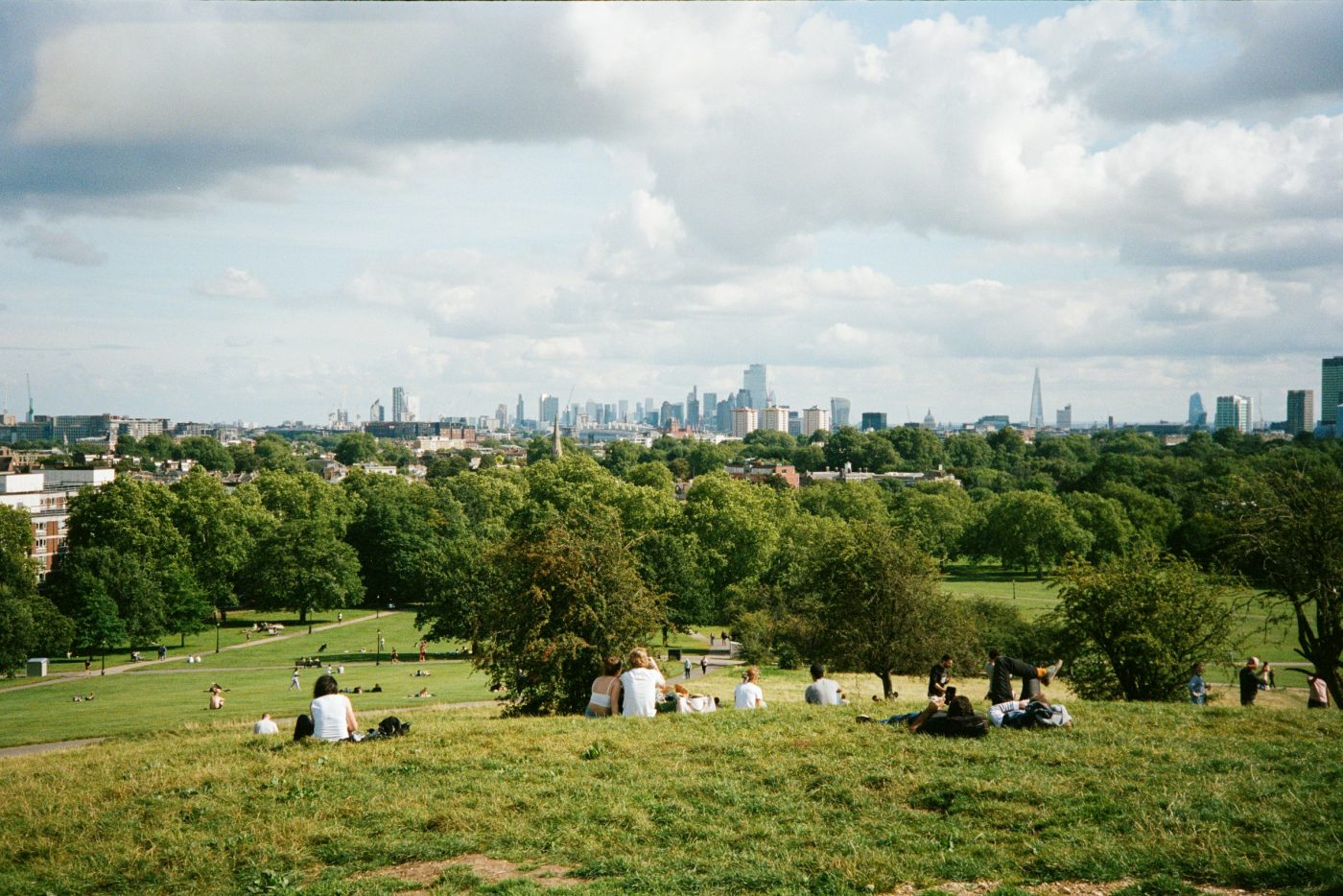
That single difference is why this is the most useful free viewpoint in London. There is no ticket, no booking, no lift, no queue and, on a weekday, no closing time, and the view from the top is legally protected, which is a sentence that can be written about very few places in this city.
Here is what is actually up there, what you can see, and the details the Royal Parks publish that nobody repeats.
The view is protected by law, and the trees are cut to keep it
The summit of Primrose Hill is almost 63 metres above sea level, and it is one of the six protected viewpoints in London.
The consequence of that designation is the thing worth knowing: the trees on the hill are deliberately kept low so that they do not obscure the view. The sightline south across central London is not an accident of landscaping, it is maintained on purpose, and it is the reason the view has not quietly disappeared behind forty years of growth the way most London viewpoints have.
In winter you can see Hampstead to the northeast, which is the Royal Parks’ own way of saying that the bare trees buy you more in January than in July. That is worth knowing if you are choosing when to go.
Our guide to the best views in London ranks the viewpoints by what you have to arrange rather than what you have to pay. Primrose Hill sits at the top of that measure, because the answer is nothing.
Open all night on weekdays, which almost nothing else is
The Royal Parks publish it plainly: The Regent’s Park pedestrian gates run 5am to 7pm, and Primrose Hill is open 24/7, with one exception. From April to November the hill closes from 10pm to 6am on Friday, Saturday and Sunday nights.
So sunrise and the small hours are both legitimately available on a weeknight, for free, from a hill with a protected view of the City. Very little in London is both free and genuinely open at four in the morning.
That exception is new. The Royal Parks charity began installing gates on Primrose Hill in March to support closures, and the weekend night closures are what they are now used for. If you are making a special trip at an odd hour, check the Royal Parks site that week rather than assuming.
What is actually on the hill
A William Blake inscription at the summit, set in York stone edging. It reads: I have conversed with the spiritual sun. I saw him on Primrose Hill. Most people stand on it while photographing the skyline and never look down.
Shakespeare’s Tree. An oak on the slope of the hill, planted in 1864 to mark the 300th anniversary of Shakespeare’s birth. A large crowd of workmen marched through London to watch the planting. The tree you see is not that one: a replacement was planted in 1964, on the four hundredth anniversary, which is a detail almost every guide gets wrong.
The Primrose Hill Café, which does hot and cold drinks, wraps, sandwiches and snacks. It is a café on a hill, not a destination, and it keeps ordinary hours rather than the hill’s.
The history, which is rougher than the postcode suggests
Primrose Hill is now one of the more expensive addresses in north London. It did not start that way.
The land was part of a great chase appropriated by Henry VIII, and later bought from Eton College in 1841 specifically to extend the parkland available to the poor people of north London for open-air recreation. It was created as public space for people who had none, which is a better founding story than most parks can claim.
Before that it was where duels were fought and prize fights were held. The hill had what the Royal Parks tactfully call a somewhat lively reputation, and the prophetess Mother Shipton is attached to it by legend, having supposedly warned of what would happen if London’s sprawl ever reached its boundaries. It did, and the hill is still there.
The questions people actually ask
Is it worth visiting? Yes, and the honest version is that it takes about twenty minutes. This is a hill with a view, not an afternoon. Build it into something else: the zoo is next door, The Regent’s Park is across the road, and Camden is a fifteen minute walk.
Is it a wealthy area? Yes. The village at the foot of the hill is one of the more expensive parts of north London and the high street prices reflect it.
Does anyone famous live there? It is a popular search and it has a well known answer that this guide is not going to help with. Pointing readers at private addresses is not something we do, and the people who live there have to walk up the same hill as everyone else.
When should you go? Sunset for the view, sunrise for the quiet, and winter for the extra sightline. A clear cold January afternoon is the best version of this place and the least crowded.
Practical notes
It is a genuine climb. Not a long one, but the summit is 63 metres and the path is steep enough to notice. There is no lift, which is the trade for there being no ticket.
Bring something to sit on. The grass is grass, and in London it is usually damp.
Combine it with The Regent’s Park, not instead of it. They are separated only by Prince Albert Road and ZSL London Zoo, and the two together make a proper morning.
Go up the north side if you want the reveal. The view does not appear until the last few metres, which is the whole pleasure of the place and is ruined by approaching along the ridge.
Everything here was taken from The Royal Parks’ own published pages and rechecked on 2 October 2026. The opening hours were corrected on 28 September 2026 from the same pages, which now publish the weekend night closures. Check before a special trip at an unusual hour.
Where to go next
Little Venice is the other end of the canal walk.
London Zoo is on the other side of the hill, and Chalk Farm is the better station for walking there.
The best views in London puts Primrose Hill against the paid platforms and the other free ones, ranked by what you have to arrange rather than what you have to pay.
The best parks in London covers The Regent’s Park next door and the other royal parks, including the two other viewpoints that need no ticket and have no closing time.
Things to do in Camden covers the rest of the walk down the hill, including the waterbus that runs from the market to Little Venice in about 45 minutes.
Free things to do in London has the rest of what costs nothing, and Camden Market is the obvious other half of a morning up here.
Questions we get asked
Is Primrose Hill free?
Yes, entirely. There is no ticket, no booking and no admission charge, which makes it the cheapest of London's good viewpoints by a distance. It is also one of the six protected viewpoints in London, which means the sightline across the city is maintained by law rather than by luck, and the trees on the hill are deliberately kept low so that they do not obscure it.
What time does Primrose Hill close?
On a weekday it does not. The Royal Parks publish Primrose Hill as open 24 hours, except from April to November, when it closes from 10pm to 6am on Friday, Saturday and Sunday nights. The adjoining Regent's Park runs its pedestrian gates from 5am to 7pm. Gates were installed on the hill in March 2026 to make those closures possible, so check the Royal Parks site before a late weekend visit.
How high is Primrose Hill?
The summit is almost 63 metres above sea level. It is a real climb rather than a stroll, steep enough to notice but short, and there is no lift or alternative route to the top. The reward is a protected view south across central London, and in winter you can also see Hampstead to the northeast once the trees are bare.
Why is Primrose Hill famous?
Three reasons. The protected view over London from a 63 metre summit, which is maintained by keeping the trees low. The literary associations, including a William Blake inscription set in York stone at the summit reading I have conversed with the spiritual sun, I saw him on Primrose Hill. And the village at its foot, which is one of the more expensive and well known addresses in north London.
What is Shakespeare's Tree on Primrose Hill?
An oak on the slope of the hill, originally planted in 1864 to mark the 300th anniversary of Shakespeare's birth, with a large crowd of workmen marching through London to watch the ceremony. The tree standing there now is not the original: a replacement was planted in 1964, on the four hundredth anniversary. Most guides describe the current tree as the 1864 one, which it is not.
How long do you need at Primrose Hill?
About twenty minutes for the hill itself, which is the honest answer. It is a viewpoint rather than a day out. The sensible approach is to build it into something larger: The Regent's Park is directly across Prince Albert Road, ZSL London Zoo sits between them, and Camden is roughly a fifteen minute walk away, so the hill works best as the high point of a longer walk.
Written by Robert J Wills, no. 160 in the guide.
Last checked 2 October 2026 against the venues' own published information. Nobody pays to appear here and we take no bookings.