London has no Michelin starred Korean restaurant. Not one. The Michelin Guide lists three Korean restaurants in the whole city, and none of them holds a star or a Bib Gourmand.
For a city with this much money and this many restaurants, that is a strange gap, and it gets stranger. Not one of those three is in central London. They are in Merton, Stoke Newington and Hackney. The Korean strip that visitors are sent to, off Piccadilly and around Soho, has nothing in the Guide at all.
And the largest Korean community in the country is not in any of those places. It is in New Malden, in outer southwest London, twenty minutes by train from Waterloo.
So the honest version of this guide is not a ranked list. It is a map of where the food actually is, which is nowhere near where the search results point.
The three in the Michelin Guide
Checked on 26 September 2026 and rechecked on 28 September. All three carry the Guide’s Bibendum symbol, which means selected and inspected. None carries a star. None carries a Bib Gourmand.
| Restaurant | Where | Price |
|---|---|---|
| ssam ssam | 149 Merton Road, SW19 1ED | £ |
| Calong | 35 Stoke Newington Church Street, N16 0NX | ££ |
| Miga | 1 Mare Street, Hackney, E8 4RP | ££ |
ssam ssam is the cheapest of the three and the Guide files it under “eat like a local”, which is the category it uses for neighbourhood restaurants rather than destinations. It handles its own bookings, so there is no online reservation system to go through.
Calong in Stoke Newington is the work of chef owner Joo Won, and the Guide traces it to a trip back to Korea that prompted him to open it.
Miga on Mare Street is family owned and run, which the Guide singles out as the thing you feel when you walk in.
Three restaurants. For comparison, on the same global Korean listing, New York has more than twenty. That is not a criticism of the three, which are good. It is a description of how thin the top of this market is in London.
The starred one that does not count as Korean
There is a complication, and it is the answer to the question people actually ask.
Sollip, at 8 Melior Street in Southwark SE1 3QP, holds one Michelin star. It is Korean run, the cooking draws on Korean ingredients and technique, and it is one of the most admired small restaurants in London.
But Michelin classifies it as “Creative”, not Korean, which is why it never appears when you filter the Guide for Korean food and why every list you read says there is no starred Korean restaurant in London. Both things are true at once, depending on whose definition you use. It is ££££ and it manages its own bookings.
If what you want is a starred restaurant run by Korean chefs, that is Sollip. If what you want is Korean food as Koreans in London eat it, keep reading, because that is a different journey entirely and it goes south.
New Malden, which is the real answer
The Royal Borough of Kingston upon Thames is, in its own council’s words, “home to one of Europe’s largest Korean communities”. The centre of it is New Malden, where the high street runs on Korean restaurants, bakeries, cafes and supermarkets rather than the usual chains.
This is not a marketing claim. The council has built policy around it:
Kingston was the first place in Europe to mark 22 November as Kimchi Day.
On 20 November 2024 the council signed a Memorandum of Understanding with Nam-gu district in Gwangju, South Korea, setting out the intention to open the first Kimchi School anywhere outside Korea, working with the Korean British Cultural Exchange Foundation and Gwangju Munhwa Broadcasting Corporation. It was signed by Kim Byung-nae, Mayor of Nam-gu, and Councillor Andreas Kirsch, Leader of Kingston Council. The hope stated at the time was to open in September 2025.
A status, because this matters if you are planning a trip around it: as of 28 September 2026 the council has published no further announcement confirming the Kimchi School has opened. The intention is on the record. The opening is not. Treat it as planned rather than running.
The school exists as an idea because kimjang, the communal practice of making kimchi, holds UNESCO intangible cultural heritage status. That is the level this is being taken at locally, and it tells you more about New Malden than any restaurant ranking would.
Eating there
Imone, at 169 High Street, New Malden KT3 4BH, is a fair introduction: a small family run room doing Korean comfort food rather than a tasting menu. Stone bowl bibimbap, bulgogi, yangnyum dak and kimchi fried rice are the kind of thing on it.
The wider point about New Malden is that you do not need a shortlist. The high street is dense enough that walking it and picking a full room is a better method than arriving with one name, and the supermarkets are worth as much of your attention as the restaurants.
It is a short train ride from Waterloo, which makes it an easy afternoon rather than an expedition.
How to read a Korean menu
Three formats get called Korean food in London and they are not interchangeable. Knowing which one you are booking is most of the problem.
Korean barbecue is cooking at the table over a grill set into it. It is social, slow and best in a group of four or more, because the point is a spread. It is also the most expensive format by some distance, and the one most likely to disappoint a couple, because two people cannot order enough to make the table work.
The everyday restaurant is the New Malden model and the one the three Michelin Guide entries belong to. Stews, rice bowls, braises, fried chicken, noodles. One dish per person, banchan on the side, and a bill that looks like a neighbourhood restaurant rather than an event.
Korean fried chicken is its own thing, closer to a late night category than a dinner, and the places that do it well generally do little else.
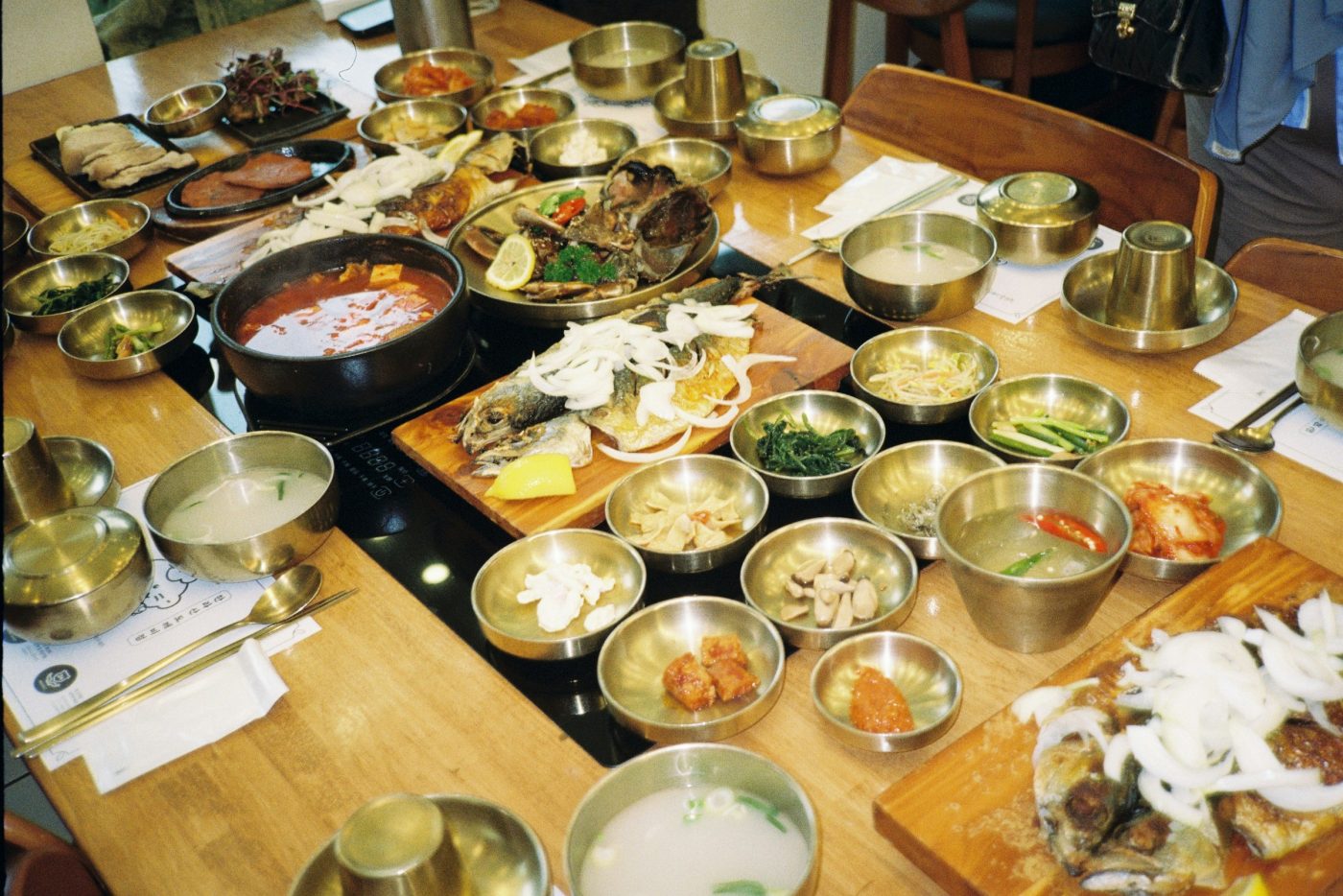
Banchan are the small side dishes that arrive unordered. They are part of the meal, not an upsell, and in a good room they are refilled. A restaurant that brings three tired ones is telling you something.
What to do with all this
If you want the best cooking, go to Sollip and accept that Michelin calls it Creative.
If you want a proper Korean dinner in town, go east rather than central. Calong and Miga are both in Hackney, both in the Guide, and both cost less than the Soho restaurants that outrank them in search results.
If you want to understand why London has Korean food at all, spend an afternoon in New Malden. It is the only part of this that is genuinely unlike anywhere else in the country.
If you are booking for a group, decide on barbecue or not before you choose the restaurant, because the two formats want different numbers of people.
Everything here was taken from the Michelin Guide, Kingston Council and the restaurants’ own published pages, and rechecked in full on 28 September 2026. Michelin distinctions change each year and the Guide’s cuisine categories are its own. Confirm before you travel across London for a specific one.
Where to go next
The best Japanese restaurants and the best Chinese restaurants are the nearest neighbours to this one, and both markets are considerably deeper in London than the Korean one is.
Vietnamese and Thai cover the rest of the region, and Michelin starred restaurants in London explains what the Guide’s distinctions actually mean, including the difference between a star, a Bib Gourmand and a plain listing.
The best restaurants in London is the hub for all of it, and cheap eats covers the end of the market where a good deal of the best Korean food in this city sits.
Questions we get asked
Are there any Michelin-starred Korean restaurants in London?
Not under Michelin's own Korean category. Checked in September 2026, the Guide lists three Korean restaurants in London, ssam ssam in Merton, Calong in Stoke Newington and Miga in Hackney, and all three are selected entries carrying the Bibendum symbol rather than a star or a Bib Gourmand. There is a complication though: Sollip in Southwark holds one star and is Korean run, but Michelin classifies its cuisine as Creative rather than Korean, so it never appears when you filter for Korean food.
Where do Koreans go in London?
New Malden, in the Royal Borough of Kingston upon Thames, which the council itself describes as home to one of Europe's largest Korean communities. The high street there runs on Korean restaurants, bakeries, cafes and supermarkets rather than the usual chains. Kingston was also the first place in Europe to mark 22 November as Kimchi Day. It is a short train ride from Waterloo and it is a completely different proposition from the Korean restaurants in central London.
What is the best Korean restaurant in London?
It depends what you mean by best. For cooking judged by inspectors, Sollip in Southwark holds a Michelin star, although Michelin files it as Creative rather than Korean. For Korean restaurants the Guide actually lists as Korean, there are three: ssam ssam at 149 Merton Road SW19, Calong at 35 Stoke Newington Church Street N16, and Miga at 1 Mare Street E8. For Korean food as the community eats it, New Malden rather than any single address.
Is there a Koreatown in London?
Yes, and it is not in the centre. New Malden in southwest London is the one, built around one of the largest Korean populations in Europe. There is a smaller cluster of Korean restaurants in central London around Soho and Piccadilly aimed largely at visitors, but it is not where the community is and not where the Michelin Guide's Korean entries are either, since all three of those are in Merton, Stoke Newington and Hackney.
What is the difference between Korean barbecue and a Korean restaurant?
Korean barbecue means cooking meat yourself at the table over a built in grill. It is designed for groups, it is the most expensive format, and two people generally cannot order enough for it to work properly. An ordinary Korean restaurant serves stews, rice bowls, braises, noodles and fried chicken, one dish per person, with banchan on the side. If you are booking for two, the second is almost always the better evening.
What is banchan and do you pay for it?
Banchan are the small side dishes that arrive at the table without being ordered: kimchi, pickled vegetables, seasoned greens and similar. They are part of the meal rather than an extra, and in a good restaurant they are refilled without being asked. The quality and number of them is one of the quickest ways to judge a Korean restaurant before your food arrives.
Written by Robert J Wills, no. 157 in the guide.
Last checked 28 September 2026 against the venues' own published information. Nobody pays to appear here and we take no bookings.